

FeltHappiness Hats
Make a Pennant Flag: Sunday 27th of September - Dublin
Make a Pennant Flag: Sunday 27th of September - Dublin
Couldn't load pickup availability
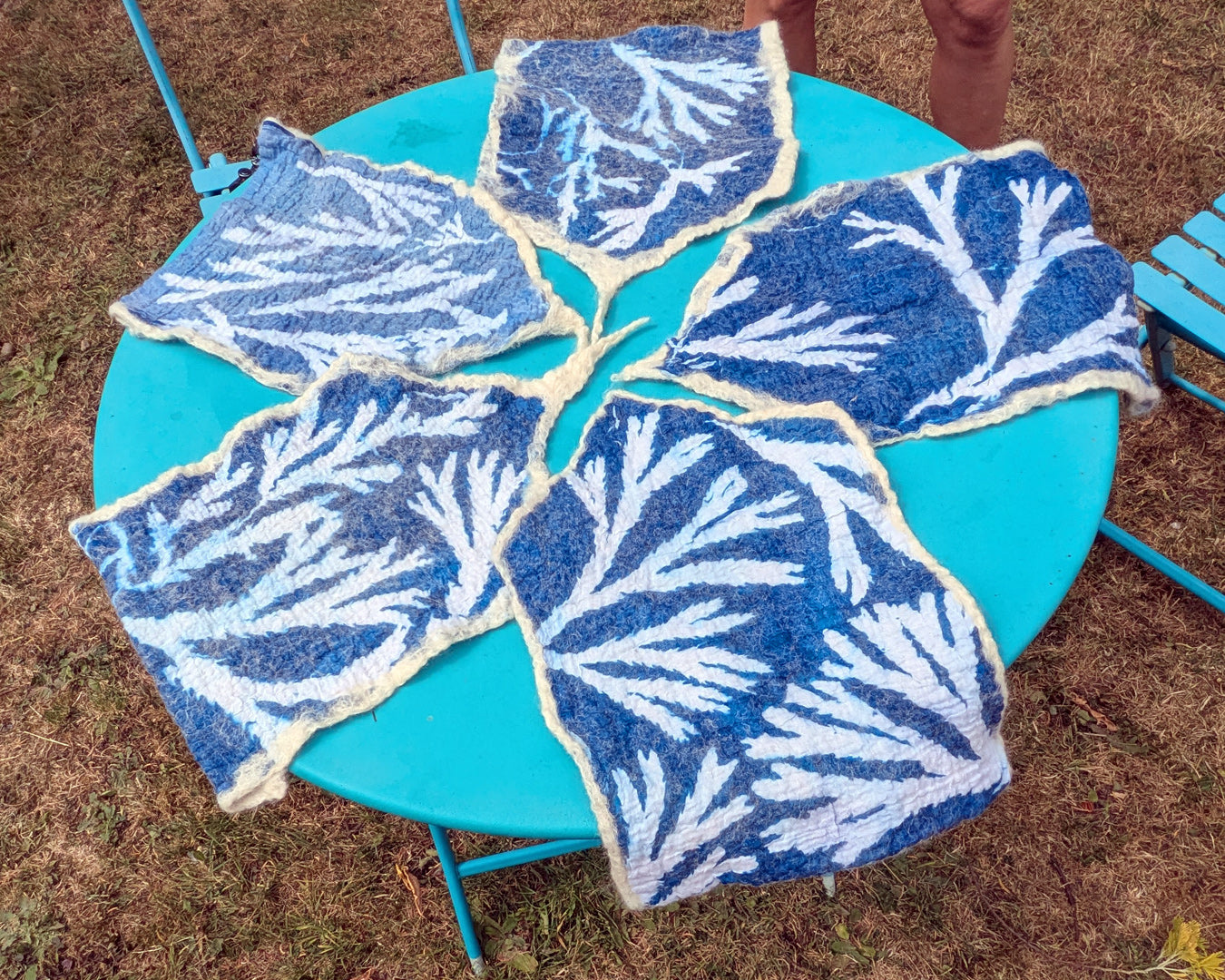
Workshop for Cyanotype Printing on Cotton Fabric and Wet Felting with Irish Wool to create a Nunofelted Pennant Flag.
50 euros per person. Places limited to 6 students.
Age 15+: This workshop is suitable for participants aged 15 and over. Anyone under 18 must be accompanied by an adult who remains with them throughout the workshop.
WHEN: Sunday, the 27th of September
TIME: 10 AM to 1 PM. Please arrive promptly, as textile-making takes time!
WHERE: 46 Balally Drive, Dundrum, Co Dublin, D16 H9P0
Ample parking in the driveway and neighbourhood. Disabled-accessible toilet. There is a small step to enter/exit the home and the studio.
Located right around the corner from the Green Line LUAS - Balally Stop; the #44 bus stops nearby.
Tea, coffee, and homemade cake provided.
Questions? Please email: julianegorman@gmail.com
Materials
Materials
Cotton Fabric, Irish Wool, Cyanotype Chemicals
Size
Size
20 by 30 cm
Care
Care
What is Cyanotype
Cyanotype is an early photographic process discovered by John Herschel in 1842. It is a non-toxic method of printing images on paper, fabrics, or other surfaces, using negatives or silhouettes of objects. For my work, I am using the latter approach on silk fabric, with seaweed foraged from Sandycove, Dublin.
While the two iron salts used in Cyanotype have scary names, they are considered safe to use. The process uses just two main ingredients — Ferric ammonium citrate and Potassium ferricyanide. When mixed with water and then combined, they create a light-sensitive solution. Once exposed to sunlight or UV light, a bit of magic happens: the chemistry transforms, and the image slowly develops into deep Prussian blue.
Care of Cyanotype Textiles
Like the felted hats I create, Cyanotype Textiles require gentle treatment.
- If your item is washable, please hand-wash in cold water with a phosphate-free, pH-neutral mild detergent.
- Do not bleach or use harsh cleaners — they will fade the blue.
- Do not wring; instead, gently press out excess water.
- Air dry in the shade, away from direct sunlight.
- Store away from the sun when not in use to preserve the colour.
Like living creatures, Cyanotypes need oxygen. If the blue appears dull after washing or storage, let the fabric breathe in open air, and the colour will revive naturally.
What is Felt?
What is Felt?
Each FeltHappiness Hat is entirely handmade and created from soft Merino wool fibers using the technique of wet felting. It's an ancient and simple craft that takes patience and lots of kneading to shrink the fibers into a strong, flexible, and warm felt. To learn more, see HERE.
In addition to insulating, wool naturally resists water. Hence, your felted hat will keep you warm in chilly weather and dry in light rain. Plus, wool resists mildew, dirt, and fire!
It's magical stuff!
Measuring Your Head
Measuring Your Head
Every head has its own unique size and shape, which can be measured with a flexible tape measure or even a piece of string.
Take the tape measure and encircle your head, just above the top of your ears. Make sure that the tape measure goes over that small bump at the back of your head. Please don't pull it tightly. Leave a little 'ease' so that one finger can fit under the tape. An ear-to-ear measure can be helpful too.
Measure three times: it is surprising how it can vary!
Inches or centimetres are fine.
Sustainability
Sustainability
While Ireland is full of sheep, sadly, the wool from Irish flocks is being used less and less. There are several reasons for this — one major factor is that many local wools don’t have the same softness as imported Merino wool. As a result, farmers receive very little for their fibre. In fact, it often costs more to shear a sheep than the farmer earns from selling the wool — if they can sell it at all. Shockingly, Irish wool is frequently treated as a waste product.
This decline in the use of wool began after the rise of polyester clothing and fast fashion, when synthetic fibres became cheaper and more convenient to produce. As these man-made materials flooded the market, demand for natural fibres like wool dropped dramatically — and their value followed.
Using locally sourced materials can make a real difference — both for the environment and for the local economy. By supporting Irish farmers and working with what’s readily available, we can reduce transport emissions and help create a more sustainable supply chain.
Here at FeltHappiness Hats, I’m committed to increasing the amount of Irish-raised fibre in my creations — striving for greater sustainability while still crafting the unique, joyful hats you love.
As of 2023, every hat in my new collections* includes at least one layer of Irish-raised wool. My most recent series, The SeaSun Cyan Collection, is made primarily — and proudly — from Irish wool.
*Note: Certain items, such as cowls, still require fine Merino fibres to ensure they’re soft and comfortable when worn close to the skin.